
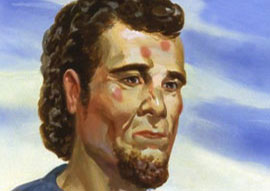
 Leviticus 14 tells us about the regulations for the people with “scale disease” at the time of their cleansing. There are many discussions about these particular rituals, and many scholars disagree on that. I suggest focusing on clearly understandable aspects of “scale disease” and learning some lessons.
The “Scale Disease” Made a Person Unclean
The Hebrew word saraat most probably incorporated several diseases. We do not know for sure if what we know as Hanseh’s disease was included in the list of illnesses under the umbrella of saraat. Most likely, it was a part of this list. The main problem for people who experienced saraat was their inability to enter the temple where God dwelled and to participate in the worship there. Such a person was banished from society as well. Thus, a leper became alien to God and to his or her compatriots.
The “Scale Disease” Made a Person “Alive Dead”
Roy Gave made a very important observation:
Several pieces of evidence link scale disease to death, indicating that it could be characterized as the “blight of the living dead.” (1) Miriam was temporarily smitten with scale disease because she and Aaron jealously spoke against Moses and his divinely appointed authority (Num. 12). Aaron vividly described the horror of her condition when he confessed to Moses and begged for mercy on Miriam: “Let her not be as one dead, who emerges from his mother’s womb with half his flesh eaten away” (Num. 12:12 NJPS). Thus, people whose flesh was rotting away with scale disease looked like they were living dead!
(2) Aside from being socially marginalized by living apart from others for the duration of the scale disease (Lev. 13:46; cf. Num. 5:1–4), the sufferer had to adopt a self-stigmatizing appearance and behavior by wearing torn clothes, letting his hair be disheveled, covering the lower part of his face, and calling out, “Impure! Impure!” (Lev. 13:45; NIV, “Unclean! Unclean!”). Calling out like this warned people to avoid contamination by contact with him. However, the condition of his clothes and hair were like that of one mourning for the dead (Targum Pseudo-Jonathan; cf. Lev. 10:6; 21:10). For whom was he mourning? Himself! Perhaps his funerary appearance intensified his need to call out while covering part of his face in order to clarify the nature of his mourning so that others would not approach to comfort him. [1]
The Hope
Indeed, leprosy, or saraat, was terrible, especially taking into account the state of medical science 3000 years ago. However, Lev. 14 begins with a hope: if this ritual is described, it means it is possible to get healed. The Holy Scripture usually associates healing from such a disease with God’s miracle (Exod. 4:6, Num. 12:10, 2 Kgs. 5:1).
The Berit Hadashah (New Testament) Fulfillment
Yeshua saw the cleansed lepers as a sign of the Messianic age.
"The blind receive sight and the lame walk; the lepers are cleansed and the deaf hear; the dead are raised up; and the poor have the gospel preached to them." Matt. 11:5[2]
All sinners became like lepers, like leaving dead, and the Messiah not only healed selected persons but gave hope and a future to everyone diseased by the leprosy of sin. People diseased with sin are not aliens, neither to God nor to angels.
Daniel Gordan
Image courtesy of FreeBibleimages
[1] Walton, John H.; Gane, Roy; Block, Daniel I.. NIVAC Bundle 1: Pentateuch (The NIV Application Commentary) (Kindle Locations 41524-41529). Zondervan. Kindle Edition.
[2] Scripture quotations taken from the New American Standard Bible® (NASB), Copyright © 1960, 1962, 1963, 1968, 1971, 1972, 1973, 1975, 1977, 1995 by The Lockman Foundation, used with permission. www.Lockman.org.