
 “Leviticus 9 belongs to the founders. It describes the very first sacrificial officiation of the Aaronic priesthood, inaugurating a worship system that lasted for over a millennium.”[1] This chapter describes how newly appointed priests performed their sacrifices.
According to the Torah, there were two major groups for whom the sacrifices were made: the priests did it for themselves and the people.
Important Sacrifices
The sacrifices for the priests were (verse 2): a calf (namely the bull) and a ram.
The sacrifices for the people were (verse 3): a male goat, a calf, and a lamb, an ox, and a ram, and a grain offering.
Thus, for the entire congregation, the priests sacrificed seven animals and brought the grain offering.
The purpose of these offerings was to make an atonement (verse 7), but first and foremost, they were to prepare people for something very special.
“This is the thing which the Lord has commanded you to do, that the glory of the Lord may appear to you.” Lev. 9:6[2]
The Glory of God Appeared
After a long and detailed list of the priest’s activities (verses 8–21), Moses presents the culmination of this worship.
Then Aaron lifted up his hands toward the people and blessed them, and he stepped down after making the sin offering, the burnt offering, and the peace offering. Moses and Aaron went into the tent of the meeting. When they came out and blessed the people, the glory of the Lord appeared to all the people. Then fire came out from before the Lord and consumed the burnt offering and the portions of fat on the altar, and when all the people saw it, they shouted and fell on their faces. (Lev. 9:22-24)
Elijah
This story parallels the story of Elijah and his contest with Baal’s prophets.
In times of calamity and struggle with the alien cult, God’s prophet Elijah was not supported by the people. Being asked by Elijah, “If the Lord is God, follow Him; but if Baal, follow him,” “the people did not answer him a word.” (1 Kgs. 18:21)
Elijah proposed to have a sort of contest: to have two oxen and to make a sacrifice without fire. The prophets of Baal failed the test, whereas Elijah appeared as a victor. The fire miraculously fell and consumed the burnt offering. As result,
When all the people saw it, they fell on their faces, and they said, “The Lord, He is God; the Lord, He is God." (1 Kgs. 18:39)
Parallels
Very often, this story is viewed separately from the book of Leviticus and is perceived as a bright action, which is to some extent true. However, in order to understand this story more deeply, one should carefully read it in light of Lev. 9.
Both stories contain sacrifices, both accounts prepare the people to meet the Lord, both contain such a detail as a miracle of fire, and, finally, the people react very similarly.
“And when all the people saw it, they shouted and fell on their faces.” (Lev. 9:24)
“When all the people saw it, they fell on their faces, and they said, ‘The Lord, He is God; the Lord, He is God.’” (1 Kgs. 18:39)
In Hebrew, exactly as in English, both phrases are written very similarly, with the exception of the people’s shouting. In Leviticus, people “shouted and fell on their faces," whereas in 1 Kings, "they said, ‘The Lord, He is God; the Lord, He is God’” which answered Elijah’s initial question.
Connection with Moses
When put side by side, these two stories demonstrate the importance of Moses’ tabernacle and its influence on Elijah’s ministry. His test of Baal’s prophets was to demonstrate that Elijah’s was a legitimate successor of Moses and that his and only his ministry continued the true God’s worship. Probably because of that, Moses and Elijah together appear in the New Testament (Matt. 17:3).
Daniel Gordan
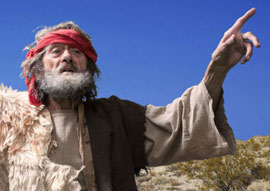
Image by: FreeBibleimages
[1] Walton, John H.; Gane, Roy; Block, Daniel I.. NIVAC Bundle 1: Pentateuch (The NIV Application Commentary) (Kindle Locations 40232-40233). Zondervan. Kindle Edition.
[2] Scripture quotations taken from the New American Standard Bible® (NASB), Copyright © 1960, 1962, 1963, 1968, 1971, 1972, 1973, 1975, 1977, 1995 by The Lockman Foundation, used with permission. www.Lockman.org.