
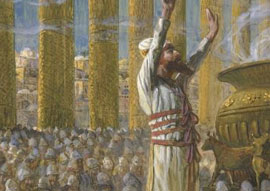
Beginning with chapter 35, the book of Shemot (Exodus) reveals to its readers details of the tabernacle construction. Moses meticulously described how small and big elements of the tabernacle were created.
Liberation, New Creation, and Atonement Connected
After the tabernacle was constructed, Moses received a commandment to set it.
Exod. 40:2 “On the first day of the first month, you shall set up the tabernacle of the tent of meeting."
The first day of the first month was the day of Pesach (or Passover), which links the tabernacle and its sacrifices with the story of Exodus. Passover began the new era of freedom when, under God’s guidance, the Hebrews left Egypt. And the story of the tabernacle is presented as a continuation of the Exodus.
Following God’s commandments, Moses erected the tabernacle (Ex. 40:18) and its pillars, spread the tent (40:19), brought the Ark of the Covenant (40:21), and arranged everything exactly as God commanded him to do.
The story of the tabernacle construction finishes with words,
Exod. 40:33: "He erected the court all around the tabernacle and the altar, and he hung up the veil for the gateway of the court. Thus, Moses finished the work."
The last words echo the creation account:
Gen. 2:1: "Thus the heavens and the earth were completed, as were all their hosts."
One more parallel may be observed in the pattern of commandment-response, which appears both during Creation and the tabernacle construction. In Bereshit (Genesis), Moses uses a constant, almost monotonous sequence,
Gen. 1:3: "Then God said, “Let there be light," and there was light."
The monotonous repetition in the text constructs a beauty of the Creation story when any God’s word is fulfilled perfectly and absolutely (which created a contrast with God’s words "do not eat" and the following disobedience of Adam and Eve). Exactly as in the Creation account, one finds a pattern: “God said"—"was” fulfilled"—in the tabernacle story.
Exod. 40:1: "Then the LORD spoke to Moses, saying"
finds its perfect and absolute fulfillment in
Exod. 40:16: "Thus Moses did; according to all that the LORD had commanded him, so he did."
And exactly as in the beginning God created the heavens and the earth, Moses and his aids created the tabernacle.
When a man was created out of the dust, he could not move until God, in Genesis 2:7, "breathed into his nostrils the breath of life; and man became a living being.” Similarly, the mobile sanctuary being beautifully designed by humans lacked the central part: God’s presence. The cloud that covered the tabernacle played a similar role to the role of God’s Spirit in Genesis.
Exod. 40:34: "Then the cloud covered the tent of the meeting, and the glory of the Lord filled the tabernacle."
Without God’s presence, the sanctuary could not work; nobody would receive atonement without the source of holiness. As soon as the Lord Himself entered His house, it was filled with life. From this point in time, any person received a unique opportunity to come to the Lord, worship Him, receive God’s forgiveness, and, finally, receive His gift of life.
I suggest that the parallels with the story of Pesach and Creation graphically illustrate the importance and purpose of God’s sanctuary. It was His renewed creation and His plan of salvation incarnated in the tabernacle and offered to all Israelites. Thus, the tabernacle connected three central concepts of the Torah: creation, liberation, and salvation.
The Motif of the Tabernacle in Revelation 14:7
The text of Rev. 14:7 calls to “worship Him who made the heaven and the earth and the sea and springs of waters."
Many theologians have rightly observed that this text is directly connected with Shabbat.
Exod. 20:8: “Remember the Sabbath day to keep it holy."
Exod. 20:11: “For in six days the LORD made the heavens and the earth, the sea and all that is in them, and rested on the seventh day; therefore, the LORD blessed the Sabbath day and made it holy."
However, the parallel between Moses’ construction of the tabernacle and the Creation account allows for an even deeper understanding. If the tabernacle demonstrates a connection with Pesach and Creation, then it will be reasonable to suggest that the reference to Creation and to the One Who Created in Rev. 14:7 may also allude to the Temple and cosmic liberation. And the context of Rev. 14:7 proves the correctness of this assumption.
Rev. 14:6-7: "And I saw another angel flying in midheaven, having an eternal gospel to preach to those who live on the earth and to every nation, tribe, tongue, and people; and he said with a loud voice, “Fear God, and give Him glory, because the hour of His judgment has come; worship Him who made the heavens, the earth, the sea, and the springs of waters.”
The eternal gospel in 14:6 plays the same role as Moses’ tabernacle. Thanks to this gospel, individuals receive salvation and liberation, and the reference to creation strengthens the connection of this text with Moses and his ministry and also with the Temple, which is in heaven.
Before the angels proclaim their messages, John sees “Lamb standing on Mount Zion” (verse 1), who is the Temple of New Jerusalem (Rev. 21:22), and whose body was the Temple of God (John 2:18–21).
It helps readers understand the idea of Rev. 14, which follows Rev. 13.
Rev. 13 describes false religion, false worship, and the beasts who impose it. Rev. 14 depicts the Messiah, who is the true temple and liberator, and the gospel the angel has in verse 6. Thus, the proclamation of the gospel by the first angel is not a repetition of Christian sermons that were preached since Yeshua’s (Jesus’s) resurrection but also a proclamation of something special connected to the tabernacle and its function. Since the Day of Atonement was the main function of the sanctuary, it is possible that the angel has “an eternal gospel” in order to proclaim the Messiah’s sacrifice and the Heavenly Yom Kippur, which is described in the angel’s words, “Fear God and give Him glory, because the hour of His judgment has come.”
The word “judgment” contains one more powerful allusion to the Day of Atonement, demonstrating that the biblical trio Creation, Liberation, and Atonement are inseparable and that the gospel may be properly understood and preached only in the context of the tabernacle and its rituals.
Daniel Gordan
Image: Public domain illustration by Tissot.
[1] Scripture quotations taken from the New American Standard Bible® (NASB), Copyright © 1960, 1962, 1963, 1968, 1971, 1972, 1973, 1975, 1977, 1995 by The Lockman Foundation Used by permission. www.Lockman.org unless other translation is indicated.