
Did God live in the Temple, or do all the verses that mention His dwelling there merely represent a symbol? It is not unusual to find in biblical commentaries such words as “the Ark was a symbol of God’s dwelling” or "God was symbolically presented in the Tabernacle.”
The scholars who hold the position of “symbolic representation” often base their opinion on some texts, especially 1 Kings 8:27, which I will examine below.
God Cannot Dwell in the Temple
Dedicating the Temple, Solomon said,
1 Kgs 8:27: “But will God indeed dwell on earth?" Behold, heaven and the highest heaven cannot contain you; how much less this house that I have built."[1]
This idea is repeated in 2 Chr. 2:6 and in 2 Chr. 6:18. These verses are sometimes interpreted as indicating the fact that God was not literally in the Temple. But is this correct? If one draws such a conclusion, it will be necessary to take the next step and assert that God does not dwell in the heavens either. But if this is the case, why did Solomon build the temple at all?
I suggest that Solomon poetically described God’s unlimited power and splendor and understood that mortal people could not build a perfect house for the Holy God. God was not confined, neither to the Temple nor to the heavens. God is bigger than all created things; He is holy and infinite. However, the Torah text explicitly teaches about God’s presence in the Tabernacle.
God Dwells in the Temple
The purpose of the sanctuary was described very unambiguously.
Exod. 25:8: “Let them construct a sanctuary for Me, that I may dwell among them."
“That I may dwell” is a translation of Hebrew וְשָׁכַנְתִּ֖י from שׁכן which in qal means “to settle, to reside.” This verb explicitly shows God’s intent to live with His people. And it looks like the psalmist understood this text exactly the same way.
Ps. 135:21: "Blessed be the Lord from Zion, Who dwells in Jerusalem. Praise the Lord!"
The ark played a very important role in this,
Exod. 25:21-22: “You shall put the mercy seat on top of the ark, and in the ark you shall put the testimony that I will give to you." There I will meet with you, and from above the mercy seat, from between the two cherubim that are upon the ark of the testimony, I will speak to you about all that I will give you in commandment for the sons of Israel."
It is reasonable to suggest that the holiest place in the Temple was not the only place of God’s dwelling, but rather His embassy on earth, where it was possible to meet Him in person.
The Wisdom of Rabbis: God’s Presence in the Temple
The Mishnah has a very interesting statement related to the current discussion; it says,
C.R. Hananiah b. Teradion says, “[If] two sit together and between them do not pass teachings of Torah, lo, this is a seat of the scornful. "As it is said, Nor sits in the seat of the scornful (Ps. 1:1). "But two who are sitting, and words of Torah do pass between them—the Presence is with them." (Avot 3:2 MISH-N)
What kind of presence is this? In Hebrew, it is שְׁכִינָה translated as presence, the word which derives from the same root as שׁכן which was mentioned above. Importantly, the word “tabernacle” or מִשְׁכַּן shares the same root and points to God’s presence and dwelling as well.
The Berit Hadashah (New Covenant): God’s Presence among the People and in New Jerusalem
In the New Testament, one may find the same idea of God dwelling with, or even better, in His worshippers.
First, there is a very strong parallel with Mishnaic text.
Matt. 18:20: “For where two or three have gathered together in My name, I am there in their midst.”
This saying of Jesus being placed in the context of Mishnah demonstrates the importance of gatherings in the name of Jesus.
Second, Paul develops the idea of God’s presence.
1 Cor 3:16: "Do you not know that you are a temple of God and that the Spirit of God dwells in you?"
And, finally, the book of Revelation promises,
Rev. 7:14-15: "And he said to me, “These are the ones who come out of the great tribulation, and they have washed their robes and made them white in the blood of the Lamb." For this reason, they are before the throne of God, and they serve Him day and night in His temple, and He who sits on the throne will spread His tabernacle over them."
All quoted verses show that their authors took the idea of God’s dwelling in the Temple seriously and literally, which provides a great benefit for all who worship God: He promised to be with and in every worshipper, not symbolically but literally.
Daniel Gordan
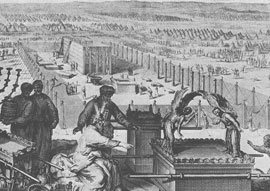
Image: The erection of the tabernacle and the Sacred vessels, as in Exodus 40:17-19; from the 1728 Figures de la Bible. Public Domain
[1] Scripture quotations taken from the New American Standard Bible® (NASB), Copyright © 1960, 1962, 1963, 1968, 1971, 1972, 1973, 1975, 1977, 1995 by The Lockman Foundation Used by permission. www.Lockman.org unless other translation is indicated.