
 The special lampstand was one of the key elements of the Tabernacle and, later, of the Temple in Jerusalem. This lampstand is called menorah from Hebrew מְנוֹרָה found in the Torah. Its importance is well illustrated by the fact that today the menorah is a symbol of Jewishness and, to some extent, Jewish statehood.
Exod. 25:31 “Then you shall make a lampstand [מְנֹרַ֖ת] of pure gold. The lampstand and its base and its shaft are to be made of hammered work; its cups, its bulbs and its flowers shall be of one piece with it.[1]
Some translations render menorah as a candlestick; however, one should remember that candles were not present in the Tabernacle. Even if ancient people used a sort of candle with wicks, Moses’ menorah was fueled by “oil for lighting” (Exod. 25:6).
The Torah says that,
Exod. 27:21 “In the tent of meeting, outside the veil which is before the testimony, Aaron and his sons shall keep it in order from evening to morning before the Lord; it shall be a perpetual statute throughout their generations for the sons of Israel.
Thus, the menorah was lit daily with specially dedicated olive oil.
The Appearance of the Menorah
There was a menorah in the Second Temple, and we know how it looked approximately. The Arch of Titus depicted Roman soldiers carrying spoils of war. The menorah is depicted there.
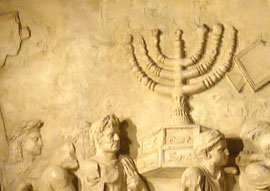
As for the shape of the first menorah, Douglas K. Stuart suggests,
Because the lampstand clearly had almond flower motifs, it is entirely understandable that many commentators have assumed that it was intended to resemble an almond tree. There is some reason to conclude, however, that it more nearly resembled an olive tree, albeit an olive tree with twenty-two almond flowers on it. Such a conclusion depends partly on two assumptions: first, that both Zechariah and Revelation refer to the Solomonic and second temple lampstands, respectively, and second, that both of these lampstands reflected the design of the original tabernacle lampstand. These assumptions are, in the final analysis, not provable. [2]
Either symbol is important. The almond tree was a symbol of God’s watching over His word.
Jer. 1:11-12: "The word of the Lord came to me, saying, “What do you see, Jeremiah?” And I said, “I see a rod of an almond tree.” Then the Lord said to me, “You have seen well, for I am watching over My word to perform it.”
This idea is derived from wordplay. The word “almond” is שָׁקֵ֖ד (shaqed) in Hebrew, whereas “watching” is שֹׁקֵ֥ד (shoqed). Thus, if the menorah were decorated like an almond tree, it could remind people about God’s presence and His watching eye.
If the menorah were designed like an olive tree, it would represent prosperity coming from the Lord and His constant care for Israel.
It is very possible that two types of elements were present and reminded us of God’s presence and His provision alike.
Important Practical Lessons of the Menorah
Interestingly, the text of the TaNaKh rarely uses the word menorah to describe something other than the temple lampstand. However, at least once this word is used in relation to a non-temple utensil,
2 Kgs. 4:10: “Please, let us make a little walled upper chamber and let us set a bed for him there, and a table and a chair and a lampstand; and it shall be, when he comes to us, that he can turn in there.”
It is reasonable to ask the question, “Why would one use the word 'menorah' when customary a word ‘nir’ is used?" The answer could be as follows: Elisha represented the Lord in Israel, while many Israelites followed two golden calves (1 Kgs. 12:28). Elisha’s ministry was a true heavenly light that encouraged people to worship the true God instead of idols.
Creating the Septuagint, translators used the Greek word “λυχνίας” to render Hebrew "menorah," the same word as Paul used in Heb. 9:2 describing the temple menorah.
Importantly, it is found in two places in the Berit Hadashah (New Testament).
First, it is mentioned in Matthew,
Matt. 5:15: "Nor does anyone light a lamp and put it under a basket, but on the lampstand, and it gives light to all who are in the house."
It is possible to suggest a connection between the menorah, Elisha’s ministry, and the disciples’ mission, which is to provide true heavenly light to the world.
The second time this word is used in relation to the early gatherings of disciples,
Rev. 1:12-13: "Then I turned to see the voice that was speaking with me. And having turned, I saw seven golden lampstands; and in the middle of the lampstands, I saw one like a son of man, clothed in a robe reaching to the feet, and girded across His chest with a golden sash."
Thus, a group of disciples was (and is) supposed to function like the menorah.
Daniel Gordan
Images: 1. The reconstruction of the menorah. Public Domain. 2. Depiction of the Menorah on a modern replica of the Arch of Titus in Rome, displayed in the Beit Hatfutsot: Museum of the Jewish People in Tel Aviv by בית השלום. Published under CC BY 3.0.
[1] Scripture quotations taken from the New American Standard Bible® (NASB), Copyright © 1960, 1962, 1963, 1968, 1971, 1972, 1973, 1975, 1977, 1995 by The Lockman Foundation Used by permission. www.Lockman.org unless other translation is indicated.
[2] Douglas K. Stuart, Exodus, NAC 2; ed. E. Ray Clendenen and Kenneth A. Mathews; Accordance electronic ed. (Nashville: Broadman & Holman Publishers, 2006), 579.