
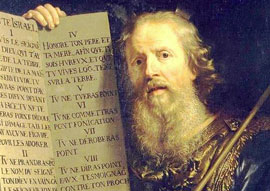
 Parashah Yitro contains the most famous verses of the Torah. In chapter twenty of the Book of Exodus, readers find something amazing, namely the words literally spoken by God and known as the Ten Commandments.
Today, the ideas of ultimate freedom, exaggerated privacy, and the larger-than-life right to be independent underlie Western society.
Consequently, any sort of pressure is considered inappropriate and inadequate, though partisans of this way of life do not hesitate to apply hard pressure to their opponents. Imposing one’s opinion is believed to be inappropriate; however, champions of freedom easily impose their opinion, advocating the idea of the inappropriateness of imposing. That is why many see the Ten Commandments as vestiges of an outdated religion.
But the Book of Exodus contains something much bigger than norms, rules, or limitations.
The Context of the Ten Commandments
In chapter nineteen, God says vital words,
Exod.19:4: "You yourselves have seen what I did to the Egyptians and how I bore you on eagles’ wings and brought you to Myself."[1]
What does it mean, “brought you to myself?”
In order to understand these words, one should recall the promise of Exodus 3:12,
And He said, ‘Certainly I will be with you, and this shall be the sign to you that it is I who have sent you: when you have brought the people out of Egypt, you shall worship God at this mountain.’
These words were given to Moses as a sign of his election and prospective successful exodus from Egypt. And now the Book of Exodus clearly states that this promise was fulfilled. The people of Israel follow the trajectory of their leader.
First, Moses left Egypt.
First, Moses came to the wilderness.
First, Moses met with God.
And now, in their turn, the people of Israel have left Egypt.
In their turn, the people of Israel came to the wilderness.
In their turn, the people of Israel met with God.
As God spoke with Moses, He spoke with the Israelites. And as God had a special mission for Moses, He had a special mission for the sons and daughters of Israel. Moses was sent to liberate the Israelites. And the Israelites, in their turn, were sent to liberate the entire world.
Exod. 19:5: "Now then, if you will indeed obey My voice and keep My covenant, then you shall be My own possession among all the peoples, for all the earth is Mine"
Exod. 19:6: "and you shall be to Me a kingdom of priests and a holy nation.’ These are the words that you shall speak to the sons of Israel.”
The words of the Ten Commandments were not said as a set of limitations, but on the contrary, these words were intended to free every person who would follow them. And furthermore, these words determined the covenant with Israel, the foundation of people’s relationships with their God.
Be Ready
Giving His Commandments to Israel, Adonai ordered them to make some preparations.
Exod. 19:10: "The LORD also said to Moses, 'Go to the people and consecrate them today and tomorrow, and let them wash their garments.'"
In Hebrew, "and consecrate” is וְקִדַּשְׁתָּ֥ם, which literally means “and make them holy.” It was necessary because the people of Israel, being humans, were about to meet the source of holiness. And this preparation assumed that it was just the beginning of sanctification, which was to meet its fulfillment in obeying God’s commandments and obtaining forgiveness and cleanliness as a result of sacrificial worship in the Temple.
The Character of God and the Echo of Egyptian Experience
The dos and don’ts are very explicit, and one should not obtain a doctorate degree in theology in order to understand God’s requirements. However, there is something even bigger behind these dos and don’ts. The Ten Commandments reveal to readers of the Pentateuch God’s character and His intents. This revelation is tightly connected with people’s experiences of the Exodus.
Exod. 20:2: “I am the LORD your God, who brought you out of the land of Egypt, out of the house of slavery.
These words precede God’s requirement to have no other gods. The LORD was the only God who was capable of bringing the Hebrews out of Egypt, and as a result, He has an exclusive right to be the only God. Additionally, Adonai reminds us about the past so that the future will be full of God’s miracles as well.
Exod. 20:4-6: "You shall not make for yourself an idol… “You shall not worship them or serve them; for I, the LORD your God, am a jealous God, visiting the iniquity of the fathers on the children, on the third and fourth generations of those who hate Me, but showing lovingkindness to thousands, to those who love Me and keep My commandments."
It is easier to understand these words in light of the plagues when “The Lord had also executed judgments on the [Egyptian] gods” (Num. 33:4). Exactly as God judged the Egyptian gods, He will judge any other idol and its worshippers, so it is vitally important to remember the experience of the Exodus.
Exod. 20:7: "You shall not take the name of the Lord, your God, in vain.”
These words, to some extent, respond to Pharaoh’s notoriously reckless words in Exodus 5:2, “Who is the Lord that I should obey His voice to let Israel go? I do not know the Lord, and besides, I will not let Israel go.” It is very possible that Pharaoh demonstrated the most impressive example of taking God’s name in vain. The catastrophic consequences that followed Pharaoh's “confession” prove that the words “the Lord will not leave him unpunished who takes His name in vain” should not be taken thoughtlessly.
The following commandment about the Sabbath in Exodus 20:8, "Remember the Sabbath day, to keep it holy,” reminds us of two important things. First, the Lord is the Creator. Second, He made the Sabbath day holy at the beginning and also commanded Moses to consecrate the people (וְקִדַּשְׁתָּ֥ם) before He came to meet with them. Thus, as the sons and daughters of Israel were consecrated and met with the Lord at Sinai, they would keep the Sabbath holy weekly and meet with the Holy God over and over.
Blessed Doers
As it was previously mentioned, Israel received a great mission to liberate the entire world. And today, thanks to Israel and the Torah, the entire world may receive and obey the Ten Commandments. These commandments bring individuals to the LORD. These commandments establish covenantal relationships with the LORD. These commandments reveal the character of God. And finally, they connect the amazing God’s work of the past with His glorious work of the future.
Daniel Gordan
Image: Moses with the Ten Commandments by Philippe de Champaigne. Public Domain.
[1] Scripture quotations taken from the New American Standard Bible® (NASB), Copyright © 1960, 1962, 1963, 1968, 1971, 1972, 1973, 1975, 1977, 1995 by The Lockman Foundation, used with permission. www.Lockman.org