
Any situation may seem helpless.
But what if humans are mistaken?
What if they see approaching failure instead of a victory?
Mighty Wilderness or Seven Lessons of Beshalach
In this weekly Torah portion, we find Israelites near the sea when “the wilderness has shut them in” (Exod. 14:3). These quoted words are part of a broader revelation given by God to Moses.
Exod. 14:2: "Tell the sons of Israel to turn back and camp before Pi-hahiroth, between Migdol and the sea; you shall camp in front of Baal-zephon, opposite it, by the sea.[1]
Exod. 14:3: “For Pharaoh will say of the sons of Israel, ‘They are wandering aimlessly in the land; the wilderness has shut them in.’"
Exod. 14:4: "Thus I will harden Pharaoh’s heart, and he will chase after them; and I will be honored through Pharaoh and all his army, and the Egyptians will know that I am the LORD.” And they did so.
One should notice a number of key elements in this passage.
How Pharaoh and Israelites Evaluated the Situation
It was not Moses’ idea or result of his poor military strategy to encamp “by the sea” at such a dangerous place; it was God’s commandment.
This is the first lesson to learn: sometimes God allows dangerous situations in order to be better revealed and glorified.
It was clearly predicted that Pharaoh would react exactly as he did. When one reads about prospective Pharaoh’s reaction, it should not be overlooked that according to the Torah, Pharaoh would say, “The wilderness has shut them in.” It is impossible to reconstruct Pharaoh’s way of thinking; however, one may assume that the Egyptian king presupposed that some of his gods were able to be swifter than the God of Israel, which resulted in that situation. If this assumption is correct, the subject in the phrase “the wilderness has shut them in” might be substituted with the name of one of the Egyptian gods. In other words, it was not the wilderness but some of the gods who finally led the Israelites to that place. And God knew about Pharaoh’s reaction beforehand.
Pharaoh behaved very similarly to contemporary skeptical scientists who assert that the Torah is full of myths and believe that the earth could spontaneously produce life, which finally evolved.
This is the second lesson to learn: God was acting against Pharaoh, who believed that the wilderness or one of the gods was fighting for him.
Israel was led by the prophet of God, to whom the Creator revealed the end from the beginning. Thus, although this situation was extremely dangerous, it was neither fatal nor hopeless.
This is the third lesson to learn: God is the LORD of hope, and this hope was revealed to the sons and daughters of Israel.
The Torah text continues to reveal the dramatic story.
Exod. 14:9: "Then the Egyptians chased after them with all the horses and chariots of Pharaoh, his horsemen, and his army, and they overtook them camping by the sea, beside Pi-hahiroth, in front of Baal-zephon."
Exod. 14:10: "As Pharaoh drew near, the sons of Israel looked, and behold, the Egyptians were marching after them, and they became very frightened; so the sons of Israel cried out to the LORD."
Exod. 14:11: "Then they said to Moses, 'Is it because there were no graves in Egypt that you have taken us away to die in the wilderness? Why have you dealt with us in this way, bringing us out of Egypt?'"
In spite of Moses’ leadership and predicted victory, the Israelites panicked. Their words echo those of Pharaoh: "You have taken us away to die in the wilderness.” Exactly as Pharaoh believed that the wilderness was the acting agent in this story, which would lead to his victory, the Israelites saw the wilderness as their possible resting place. Both Pharaoh and the Israelites believed that this situation was against them, whereas it was the consummation of the greatest deliverance in history.
How God Acted
Before God acted, Moses replied to the people,
Exod. 14:13: "But Moses said to the people, “Do not fear! Stand by and see the salvation of the LORD, which He will accomplish for you today; for the Egyptians whom you have seen today, you will never see them again forever."
Exod. 14:14: “The LORD will fight for you while you keep silent.”
According to Jewish tradition (Mekhilta), near the sea, the people of Israel were divided into four groups, and there were four types of reactions to the situation.
The first group of people wanted to cast themselves into the sea. The second group wanted to return to the land of Egypt. The third group suggested fighting. And the fourth group said that it was necessary to cry out to the LORD. The tradition says that Moses’ reply was given to these groups of people as follows:
To the first group of people who wanted to cast themselves into the sea, Moses addressed them with the words, “Do not fear! Stand by and see the salvation of the LORD."
To the second group of people who wanted to return to the land of Egypt, he said, "For the Egyptians whom you have seen today, you will never see them again forever."
To the third group of people who suggested fighting, he said, “The LORD will fight for you."
And to the fourth group of people who said that it was necessary to cry out to the LORD, Moses said, “You keep silent.”
Indeed, people react very similarly to different circumstances, but the good news is that for those who worship Him, God replies very similarly as well. To these four reactions, God has four answers.
This is the fourth lesson to learn: very often, it is necessary to stand still and be silent rather than cry, run, or fight. When God says, “Stand and be silent,” one has to be silent.
However, after the LORD divided the Red Sea, there was one important thing to do, which was go straight.
Exod. 14:22: "The sons of Israel went through the midst of the sea on the dry land, and the waters were like a wall to them on their right hand and on their left."
After standing and looking at the salvation of God, the Israelites had to go, being led by Moses.
And this is the fifth lesson to learn. When God says “go,” one has to go.
Correct Discernment
The sixth lesson to learn is this: Pharaoh believed that the wilderness or some of his gods finally became greater than the LORD of Israel. He said, "The wilderness has shut them in," expecting a great Israelite’s shutdown. And he achieved the greatest Egyptian shutdown in history. His army, and probably he himself, drowned. It happened exactly as God predicted: "And the Egyptians will know that I am the LORD.” It is obviously better to be among those who know that He is the LORD than to believe that the wilderness may shut down one’s enemies.
And the seventh lesson is practical. It is about implementing all the lessons listed above. It should be learned during one's life.
Daniel Gordan
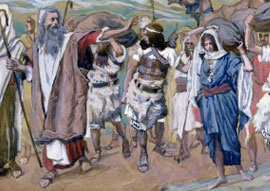
Image: The Waters Are Divided, by James Tissot. Public Domain.
[1] Scripture quotations taken from the New American Standard Bible® (NASB), Copyright © 1960, 1962, 1963, 1968, 1971, 1972, 1973, 1975, 1977, 1995 by The Lockman Foundation, used with permission. www.Lockman.org