
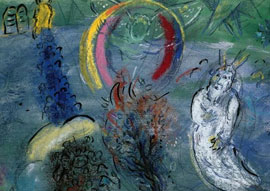
 In Exodus (Shemot), chapter 3, Moses portrays himself on the west side of the wilderness, pasturing the flock of his father-in-law. Chapter 3 describes Moses’s encounter and following the dialogue with Adonai. This meeting will completely change Moses’ plans, life, and future.
Identity
Before proceeding to the important details of this dialogue, we should pay attention to a few elements highlighted in the text. I suggest that one of the most important background details is given in the first three words of the book of Exodus: וּמֹשֶׁ֗ה הָיָ֥ה רֹעֶ֛ה which should be translated, “and Moses was pasturing…”
From a contemporary standpoint, there is nothing wrong with that. Indeed, Moses escaped from Egypt, found a place to live, and, most probably, the pasturing occupation was the only possible occupation. However, it should be taken into account that every shepherd was loathsome to the Egyptians (Genesis 46:34), and it is unlikely that Moses would pasture flocks with Egyptian identities. Moses’ occupation explicitly demonstrates that, in spite of his childhood and youth spent in the Pharaoh’s palace, he has not become an Egyptian. He remained a son of his ancestors Abraham, Isaac, and Jacob, and the God of the ancestors remained the God of Moses. Paul provides a valuable remark on Moses’ identity in Hebrews 11:24:
By faith, Moses, when he had grown up, refused to be called the son of Pharaoh’s daughter.[1]
It was Moses’ deliberate choice to remain Israelite.
Another important element is the mention of the flock owner. The herd, according to the text, belongs to Moses’ father-in-law. In other words, a former prince of Egypt now holds a position that is very close to one of Jacob’s when he was pasturing Laban’s goats and sheep. Moses, a hired worker, even theoretically cannot do any harm to powerful Egypt; mathematically speaking, this is a probability of zero. It looks like the game is over.
God Calls
It is amazing to see that God likes “a probability of zero.” By definition, all power belongs to Him, and now, regardless of the impossibility of delivering slaves, God starts acting.
First, God calls His servant saying, “Moses, Moses,” and warns him not to come near. Second, He emphasizes that Moses’ Hebrew identity is known as havens (Exodus 3:6). He said also, “I am the God of your father, the God of Abraham, the God of Isaac, and the God of Jacob.” Adonai knows that Moses’ occupation links him with his forefathers and appeals to this connection: the son of patriarchs is found in the wilderness!
Adonai demonstrates to Moses that He knows all the sufferings and afflictions of the children of Israel and that now it is time to free them.
Moses Responds
Moses replies in Exodus 3:11,
“Who am I that I should go to Pharaoh and that I should bring the sons of Israel out of Egypt?”
According to Rashi, it means, “Of what importance am I that I should speak with kings?” or “Even if I am of importance, what merit do the Israelites have that a miracle should be wrought for them, and I should take them out of Egypt?”
Moses is very humble in this situation. Indeed, “Is it not the divine prerogative to save? This should not be a human being’s responsibility. Perhaps Moses’ question is actually a show of true humility. He is not God, and hence he cannot bring the Israelites out of Egypt.”[2]
Anticipated Victory
A long dialogue that follows begins with a few key words. It is important that God give His servants (Moses and Aaron) the power and ability to do miracles. But there is something that is even more important. God says in Exodus 3:12,
“Certainly, I will be with you.”
Just six words (three in Hebrew), six simple words: “Certainly I will be with you.” These six words are more powerful than any earthly power, and that is why God says to Moses in Exodus 3:12,
“And this shall be the sign to you that it is I who have sent you: when you have brought the people out of Egypt, you shall worship God at this mountain.”
Do we want to get such a sign? Probably not. We want a sign before, not after, but one of the reasons why the sign will be given after is because one even more powerful sign is already given: “Certainly I will be with you." This sign allows for anticipating the ultimate victory.
Significance
Readers of the Torah are familiar with the end of the story. The Israelites experienced God’s presence and victory and worshiped Him exactly as it was predicted. But how about us?
The Messiah says to the disciples in Matthew 28:20,
"And lo, I am with you always, even to the end of the age.”
Messiah’s “I am with you” resonates with “Certainly I will be with you” from the story of the Exodus. These words project God’s ultimate power and victory to each and every person who believes in Him and who, like Moses, remembers: I am not an Egyptian; I am not a citizen of an earthly country; I do not belong to this world. I am a child of Abraham, Isaac, and Jacob, and their God is my God.
Daniel Gordan
Image: Moses with the Burning Bush by Marc Chagall, public domain.
[1] Scripture quotations taken from the New American Standard Bible® (NASB), Copyright © 1960, 1962, 1963, 1968, 1971, 1972, 1973, 1975, 1977, 1995 by The Lockman Foundation, used with permission. www.Lockman.org
[2] Peter Enns, Exodus. Zondervan. Kindle Edition. Location 22303.