
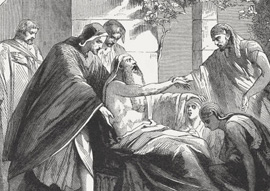
 Jacob is old and ill. Now it is apparent that the end of his earthly life is approaching. It is time to bless his children and according to the biblical text it will happen soon.
Yet, some unexpected things are about to happen, namely, adoption and the wrong order of blessing. These two elements of the narrative deserve special attention.
Adoption
In Gen. 48, we read that Joseph and his two sons came separately from other brothers.
Now it came about after these things that Joseph was told, “Behold, your father is sick.” So he took his two sons, Manasseh and Ephraim, with him. Gen 48:1 [1]
We expect to read how Jacob blessed Joseph, but instead Jacob adopted his grandkids without asking for Joseph’s consent and blessed them.
The book of Genesis tells us that Jacob was a father of twelve sons and an unspecified number of daughters, including Dinah (Gen. 46:7). This fact makes Jacob’s intent to adopt Joseph’s sons very surprising. Why was he not satisfied with the number of his kids? Why did he want to have more sons? Why was he not content with the twelve men who were born into his family? The following words from the patriarch shed some light on that.
“Now as for me, when I came from Paddan, Rachel died, to my sorrow, in the land of Canaan on the journey, when there was still some distance to go to Ephrath; and I buried her there on the way to Ephrath (that is, Bethlehem).” Gen. 48:7
Jacob describes the premature death of his beloved Rachel, from whom he expected to have more sons. What Jacob does here, to some extent, resembles a levirate marriage - a marriage in which a man restores descendants for his deceased brother. Thus, the children of Joseph have to fill lacunae, which result from Rachel’s death. Joseph was not deprived of his parent’s rights; on the contrary, he was bestowed with the right to become a co-forefather of the people of Israel.
Wrong Order
Jacob calls his grandsons,
Joseph brought them close to him, and he kissed them and embraced them. Gen. 48:10
This resembles the episode described in Genesis 27 where Isaac blessed Jacob. Both Isaac and Jacob had deemed eyes; Isaac requires “come close” and “Joseph brought… [the sons] close to him.” Isaac asked Jacob to kiss him, and Jacob, in his turn, kissed his grandsons.
One may assert that the second story contains elements from the first story due to a traditional ritual, and it will be partially true. Having said that, I intended to point out the literary features of these two narratives written by Moses. Emphasizing similar elements, he wanted to demonstrate to his readers that these two stories are theologically connected. What is the goal of this connection? I suggest that it is found in Gen. 48:13-14.
Joseph took them both - Ephraim with his right hand toward Israel’s left and Manasseh with his left hand toward Israel’s right - and brought them close to him.
But Israel stretched out his right hand and laid it on the head of Ephraim, who was the younger, and his left hand on Manasseh’s head, crossing his hands, although Manasseh was the firstborn. Gen. 48:13-14
In this text, we see that the younger brother receives Jacob’s blessing, and it happens under similar circumstances as Jacob received, or rather stole, Isaac’s blessing.
Significance of the Story
Jacob struggled with two big issues: how to receive a birthright and how to gain possessions. He buys the birthright, steals the blessing, and works for decades trying to achieve the desired result. And at the end of his life, Adonai demonstrates to him that there is something bigger than human efforts.
First, concerning possessions, we read,
and take your father and your households and come to me, and I will give you the best of the land of Egypt, and you will eat the fat of the land.’ Gen. 45:18
‘Do not concern yourselves with your goods; for the best of all, the land of Egypt is yours.’” Gen. 45:20
In other words, all efforts of Jacob’s clan are now annulled by Pharoah's and Joseph’s “Do not concern yourselves with your goods."
Second, concerning the blessing, we see that Jacob himself blessed Ephraim, who was younger, and this fact, highlighted by the details that I analyzed above, teaches us that Jacob was able to receive his father’s blessing without stealing or struggling.
It seems that Adonai sometimes expects idling instead of doing. I am neither promoting parasitism nor advocating laziness. I am trying to say that sometimes it is better to wait for God’s acts and His intervening hand than to apply all energies. Sometimes it is better to chew than talk, especially when "to talk" equals "to make it on one's own" and "to chew" equals "to get help from Adonai."
Daniel Gordan
[1] Scripture quotations taken from the New American Standard Bible® (NASB), Copyright © 1960, 1962, 1963, 1968, 1971, 1972, 1973, 1975, 1977, 1995 by The Lockman Foundation Used by permission. www.Lockman.org