
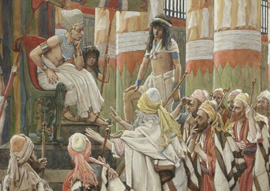
 The weekly Torah portion Vayigash communicates many important ideas. Probably, the messianic motif is one of the most important moments found in this parashah. I suggest that two characters reveal different traits of the Messiah. They are Judah and Joseph.
Judah as a Messianic Figure
The beginning of Vayigash is very emotional and dramatic. An old conflict that began decades ago comes to its resolution in Genesis 44-45. Judah, at the beginning of the weekly Torah portion, admits,
Gen. 44:16: “God has found out the iniquity of your servants; behold, we are my lord’s slaves.”
Of course, we know that the happy end is approaching. In a few moments, Joseph will weep, forgive his brothers, and later meet with Jacob. However, it is vital to keep in mind that Joseph’s brothers are not aware of with whom Judah is talking right now. Consequently, it should be kept in mind that Judah did not play a role in a college theater when he said,
Gen. 44:33: “Now, therefore, please let your servant remain instead of the lad, a slave to my lord, and let the lad go up with his brothers.”
It was a real and grievous choice that anticipated a very unpleasant retirement for Judah; very easily, he could spend the rest of his life in Egyptian prison.
Another important fact that readers of the Torah have to remember is Judah’s participation in the brothers’ decision to sell Joseph. Judah was the one who initiated this shameful act, and it looks like now Judah receives his “measure for measure punishment.” All the brothers understood it clearly. It can be seen in a remark of late repentance made in chapter 42.
Gen. 42:21: "Then they said to one another, “Truly we are guilty concerning our brother, because we saw the distress of his soul when he pleaded with us, yet we would not listen; therefore, this distress has come upon us.”
Interestingly, Judah’s words, “for you are equal to Pharaoh” (Gen. 44:18), are rendered in Targum Pseudo-Jonathan as “your judgments have turned to be like the judgments of Pharaoh,” which can be understood either as acknowledgement of Joseph’s power or as anticipation of the royal punishment.
What makes Judah a Messianic figure, a type of Messiah?
One of the key elements of this story is Judah’s transformation. A person who initiated selling Joseph to merchants, thus making him a slave, now initiates his own slavery in order to save Joseph’s younger brother. Judah repented, and his repentance led him to this transformation, and he offered himself to save Benjamin exactly as the Messiah offered Himself to save humanity.
Joseph as a Messianic Figure
Joseph represents a drastic contrast to Judah. We are not told about Joseph’s sins. We cannot find anything about Joseph’s repentance. According to the Torah, he is faithful and very consistent in his faithfulness. Joseph suffered undeserved hatred, undeserved slavery, and, finally, undeserved imprisonment. But we never find Joseph complaining or murmuring. Joseph is faithful to his father and to the God of his father. Joseph’s righteousness makes him a type of Messiah.
In Gen. 44, Joseph appears as a person whom his brothers cannot recognize. Even when he cries, his brothers cannot answer him, “for they were dismayed at his presence.” (Or according to Targum Pseudo-Jonathan, “his brothers were not able to answer him a word, for they were terrified from before him.”)
People who saw the Messiah two thousand years ago could not recognize Him either, and in the future, the majority of humans will not recognize Him. Two thousand years ago, they thought it was just a workman from a remote village. Today, those who believe that they believe in Him expect to meet a Scandinavian man stereotypically dressed in a white robe with a sheep on his shoulders. Both failures result from the predominant concept, which dictates what the Messiah should look like; however, the example of Joseph and his brothers teaches us that people may fail to recognize someone whom they supposedly knew very well.
At the end of this story, Joseph demonstrates one more amazing Messianic characteristic. He forgives,
Gen. 45:5: "Now do not be grieved or angry with yourselves, because you sold me here, for God sent me before you to preserve life."
Joseph did not only forgive his brothers, but he even saw that his slavery and imprisonment were foreordained from above in order to save the entire clan and emerging God’s people.
Significance of the Story
From the Messianic point of view, this story teaches us that God wants us to see various traits of the Messiah, paying attention to different aspects of human lives and especially to the lives of biblical characters.
The concept of the biblical Messiah is a concept of restoration. Because of Adam’s sin, the entire human race was damaged. Nevertheless, God is more powerful than sin. All who believe in God’s way of restoration will be restored in order to worship the Eternal King forever. This story graphically emphasizes such important things as substitution, repentance, and forgiveness, which eventually result in restoration and eternal life.
Daniel Gordan