
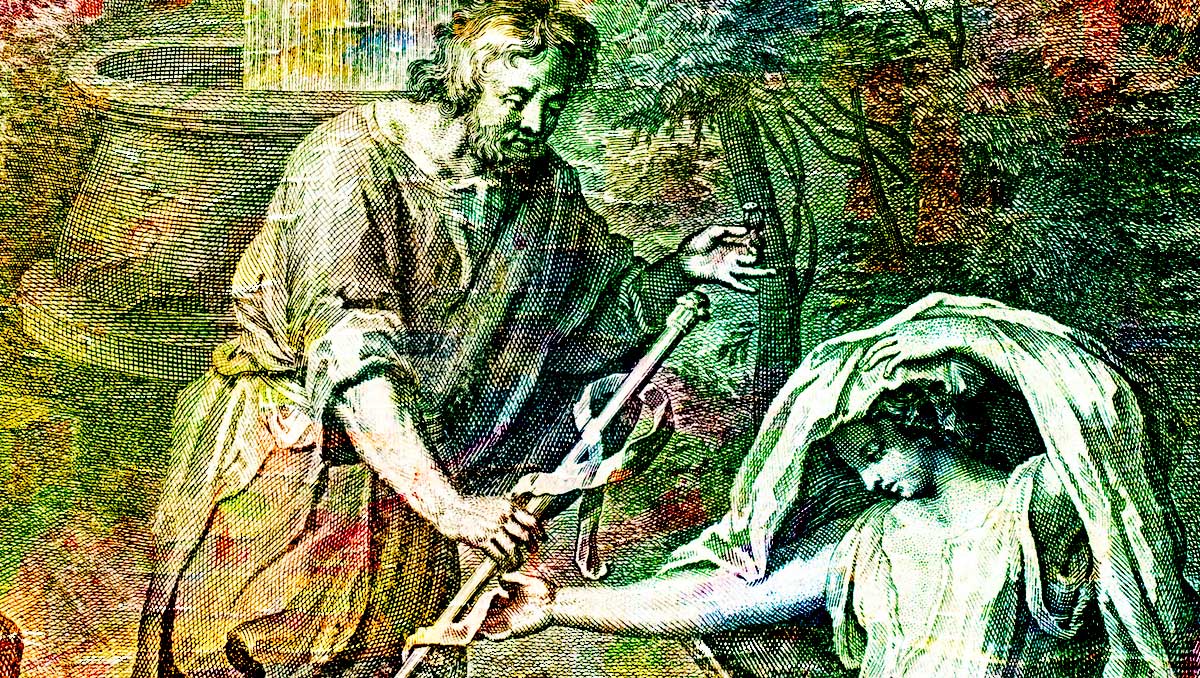
 Why does Judah decide to “depart from his brothers”? If we open the Hebrew Bible we will find that “וַיֵּ֥רֶד יְהוּדָ֖ה מֵאֵ֣ת אֶחָ֑יו” – literally, “Judah went down or descended from his brothers.” Geographically, it might have looked just like that, perhaps the place he went to was in a lowland. However, his lifestyle after he “went down” suggests that the narrative may be referring to his spiritual decline.
"Judah could not resist Tamar! She was not married; he did not know her true identity, and yet it is difficult to call his behavior here a model of righteousness."A. Vudka From Adam to the Temple.
Later, it was Judah who initiated the sale of Joseph: “And Judah said to his brothers, ‘What profit is it if we kill our brother and conceal his blood? Come, let us sell him to the Ishmaelites, and let not our hand be upon him, for he is our brother, our own flesh.’ And his brothers listened to him” (Gen. 37:26–27).
I cannot agree with commentators who suggest that Judah wanted to save Joseph. The Torah law clearly states: “Whoever steals a man and sells him, or he is found in possession of him, shall surely be put to death” (Ex. 21:16). Joseph, who was familiar with many of the later laws of the Torah given by Moses, would have known this law. Reading Joseph’s words, “For I was indeed stolen out of the land of the Hebrews, and here also I have done nothing that they should have put me into the pit” (Gen. 40:15), we see that Joseph uses the same language that Moses used to describe the enslavement of a Hebrew.
Considering that Judah surrounded himself with pagans and the behavior of his children, we can assume that Judah’s lifestyle was far from perfect. Nevertheless, Jacob gives Judah a remarkable blessing:
“The scepter shall not depart from Judah,
Nor the ruler’s staff from between his feet,
Until Shiloh comes,
And to him shall be the obedience of the people.
“He ties his foal to the vine,
And his donkey’s colt to the choice vine;
He washes his garments in wine.
And his robes are in the blood of grapes.
“His eyes are dull from wine,
And his teeth were white from milk.
(Genesis 49:8-12)
Rashi, Soncino, and many other commentaries suggest that this refers to the lineage of the Messiah through Judah.
Why was this blessing not given to the sons of Joseph? A. Vudka poses an essential question when he writes, “How did Judah surpass Joseph, a pure genius who did not stain himself... among corrupt pagans?” A. Vudka From Adam to the Temple. Here is how A. Vudka answers this question:
“Complete repentance and absolute rejection of the sin indulged in in the past can bring a person to a level that is not accessible to a righteous person from birth. The cornerstone of this idea in Judaism is ‘Teshuva’ or ‘Return.’… This is the new and higher path of service that placed Judah above Joseph. The tribes of Joseph, the dynasty of the Israelite kings, having sinned, did not know the way back. The tribe of Judah and the house of David knew it.” A. Vudka From Adam to the Temple.
Repentance is the key work in the story of Judah.