
Moses says, “Isaac was forty years old when he took Rebekah” (Gen. 25:20).[1] The long years of painful waiting almost repeat the years of Abraham’s waiting for his son. Exactly as Abraham for decades was counting days until the birth of Isaac, now Isaac, in his turn, is counting days. It is important to remember that most probably Abraham was alive during all these years and shared this sore uncertainty with his family.
These twenty years of waiting (Gen. 25:26) uncover the depth of the dramatic situation described by Moses and the importance of Isaac's prayer for his wife. “Isaac prayed to the Lord on behalf of his wife, because she was barren; and the Lord answered him, and Rebekah, his wife, conceived” (25:21). It was not a prayer for which one might pray quickly and thoughtlessly. Isaac is portrayed as a person who is struggling for his wife. Sadly, the struggle does not come to an end when Rebekah gives birth.
The struggle in the text shifts to a much higher level. Indeed, one problem is solved: Rebekah is not barren anymore. However, the text reads that “the children struggled together within her” (25:22). This process is described by the emotional Hebrew verb “וַיִּתְרֹֽצֲצ֤וּ” which in this particular form means “struggle together, kick and shove one another," and in other forms may mean “to smash” or “to smite.”[2] This fact informs us about the excessive tension, which became obvious even before the twins were born.
Rebekah Asks the Lord
The tension is so unbearable that Rebekah says, “If it is so, why then am I this way?” (25:22). The Hebrew phrase is uncertain, and sometimes it is translated as “If so, why do I exist?” or “If so, why do I need life?”
She decides to go and “inquire of the Lord” (25:22).
The Lord gives a very unfavorable answer,
“Two nations are in your womb; and two peoples will be separated from your body; and one people shall be stronger than the other; and the older shall serve the younger.”
This prophecy received according to tradition from Shem (who was still alive at that time) envelops the present and the future of the patriarchal family, and what is noticeable serves as a model of a cosmic struggle that is happening today virtually in any family in the world. Brothers who shared the womb and were near each other during their entire childhood do not love each other. On the contrary, they hate each other. Further, Moses mentions several things, such as blackmail, theft, an attempt to murder, and finally Esau’s effort to revenge himself.
What is going on?
As I said above, the situation in Isaak’s family was not unique. Cain murders Abel. Lot’s and Abraham’s shepherds struggle. Joseph is about to be killed by his brothers. These "micro struggles" later project on the history of the entire Israel when the kingdom united by David then becomes the divided kingdom. Brothers struggle, struggle, and struggle. There is something intrinsic to humans that does not allow them to achieve peace. Is there a solution in the universe?
Heavenly Shalom
The Hebrew word shalom is famous and recognizable. This word means “peace.” Today, it is used in Israel like the popular American “hello” is used around the world. The text of the Brit Hadashah (the New Testament) tells us about the importance of peace and about the way of obtaining it. Yeshua says to the disciples,
“Peace I leave with you; My peace I give to you; not as the world gives, I give to you.
Do not let your heart be troubled, nor let it be fearful” (John 14:27).
The Parashah Toldot gives us a unique opportunity to understand the words of Yeshua. When we consider the enmity between Esau and Jacob, between Cain and Abel, between Hebrew kingdoms, and even between disciples of Yeshua, we understand the price and importance of such a gift: “My peace I give to you.” The happy end of Toldot’s story is not found in the book of Bereshit (Genesis), but appears much later when, in the book of Acts, its author describes disciples: “When the day of Pentecost had come, they were all together in one place… Day by day, continuing with one mind in the temple and breaking bread from house to house, they were taking their meals together with gladness and sincerity of heart” (Acts 2:1, 46).
Daniel Gordan
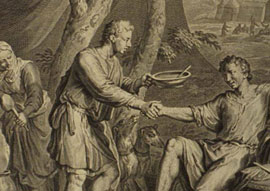
Image: Gerard Hoet, 1728 Figures de la Bible. Public domain.
[1] Scripture quotations taken from the New American Standard Bible® (NASB), Copyright © 1960, 1962, 1963, 1968, 1971, 1972, 1973, 1975, 1977, 1995 by The Lockman Foundation Used by permission. www.Lockman.org
[2] Ludwig Koehler and Walter Baumgartner, The Hebrew and Aramaic Lexicon of the Old Testament, (2002), s.v. "רצץ."