
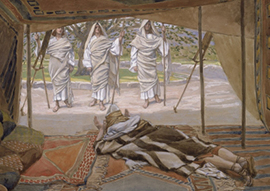
 Midrash Genesis Rabbah tells us that Abraham would greet travelers. According to the oral tradition, Abraham intentionally placed his tent in the center of a crossroads in order to accommodate people who were traveling.
It was Abraham’s custom to wash the feet of the traveler (as all nomads do) and to feed the traveler.
Then, when the traveler would thank Abraham for his hospitality and for the meal, Abraham would say, “Nay, do not thank me, but thank Adonai.” The traveler would ask, “Who is this Adonai?” And so Abraham could enlighten each traveler with knowledge of the One God, the Creator of heaven and earth, and all that is therein.
Once, an old man appeared at the door of Abraham’s tent, and Abraham welcomed him as always, washing his feet and preparing him a meal. But after the meal, when Abraham asked the old man to thank Adonai for the blessing of food, the old man replied that he worshiped only fire and would thank no other god but the god of flame and ash. “Moreover,” the old man said, “when I am forced to build my own fire, the only god I thank is the god of my own fingers!”
This aggrieved Abraham, and he drove the old man out of his tent into the chill of the desert night. At once, God’s voice came to Abraham, saying, “Wherefore have you done this shameful thing? For seventy years, I have suffered from this old man. Can you not suffer him even for one night?”
Then Abraham made haste to chase after the old man. He brought him back to the warmth of his tent and kept him there for the night.[1]
It is unlikely that this Midrash communicated historical facts, since Midrash as a genre was to interpret the meaning of the biblical text, not to improve it. Consequently, readers of Midrashim deal with rabbinical understanding, which very often represents an important background element and allows them to learn some lessons. According to Midrash, it was Abraham’s custom to accommodate travelers; in other words, he was doing that constantly. He accommodated people regardless of their religious or national identity. Abraham typically did not know who they were and did it for the sake of his God.
All these elements perfectly correspond with two quotations from Berit Hadashah.
First, let us look at Yeshua’s words:
Matt. 25:37: "Then the righteous will answer Him, ‘Lord, when did we see You hungry and feed You, or thirsty and give You something to drink?
Matt. 25:38: "And when did we see You as a stranger, and invite You in, or naked and clothe You?[2]
The disciples described in this discourse behaved exactly like the father Abraham. They provided food, water, and shelter to someone whom they did not know, and as a result, they accommodated God Himself.
Second, let us look at Paul’s words:
Heb. 13:2: "Do not neglect to show hospitality to strangers, for by doing so, some have entertained angels without knowing it."
The pious behavior mentioned in the second quotation matches Abraham's habits.
Once, replying to opponents, Yeshua said in John 8:39, "If you are Abraham’s children, do the deeds of Abraham.” These words perfectly conclude this brief study, challenging us. Are we ready to follow our father, Abraham?
Daniel Gordan
Image: Illustration by James Tissot, public domain.
[1] Rossel, Seymour. The Essential Jewish Stories: God, Torah, Israel & Faith. Rossel Books, pp. 220-221.
[2] Scripture quotations taken from the New American Standard Bible® (NASB), Copyright © 1960, 1962, 1963, 1968, 1971, 1972, 1973, 1975, 1977, 1995 by The Lockman Foundation Used by permission. www.Lockman.org.