
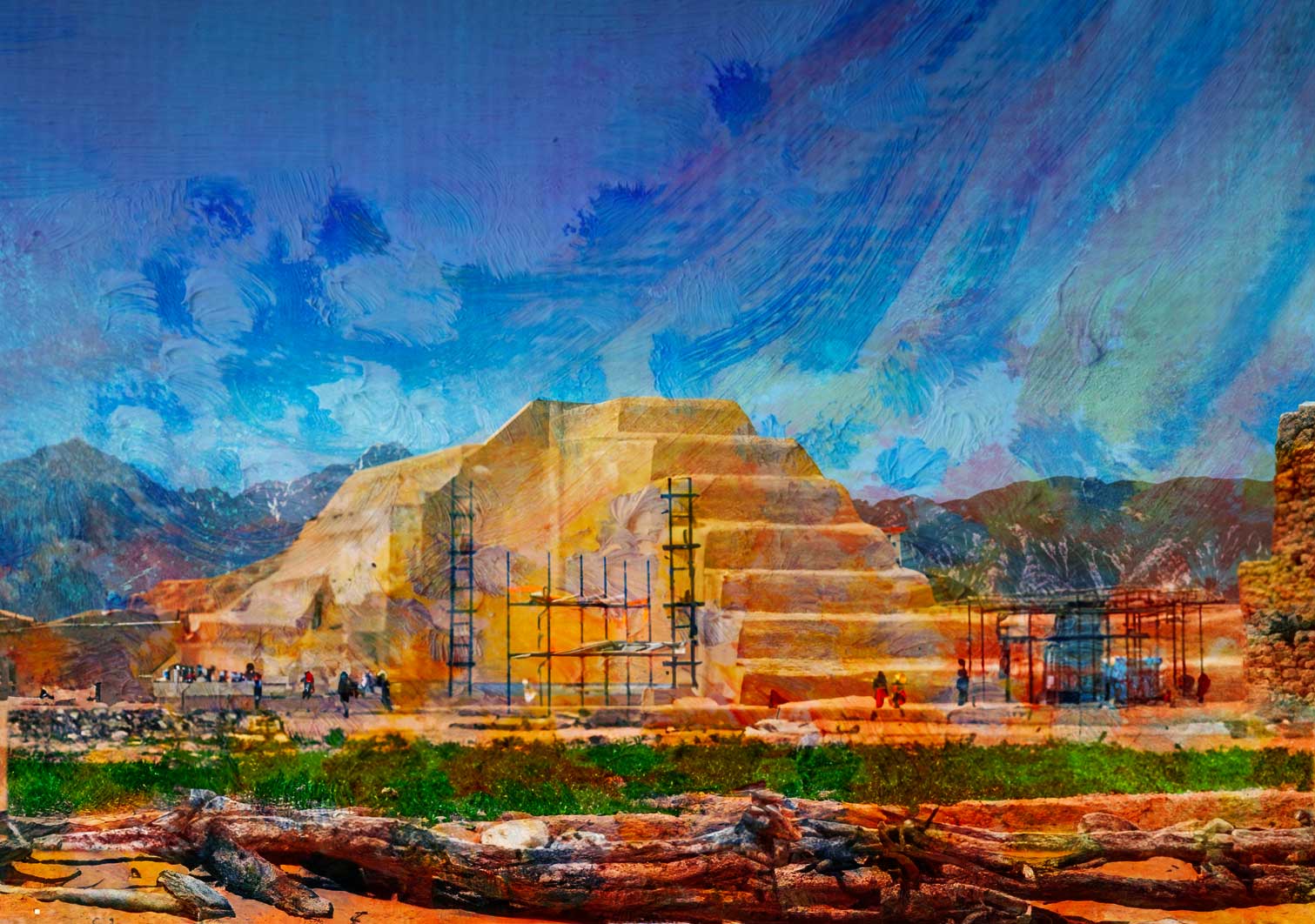
In this weekly Torah portion, we encounter the story of the Tower of Babel.
The whole earth spoke a single tongue. As people moved eastward, they found a plain in the land of Shinar and settled there. They decided to make bricks and bake them. The builders wanted to create a city and a tower whose top would reach the heavens. Their goal was to make a name and not be scattered abroad. After that, something unexpected happened.
Adonai came down to see the city and the tower that the sons of man had built. God said, “Look, the people are one, and all of them have the same language. So this is what they have begun to do. Now, nothing they plan to do will be impossible. Come! Let us go down and confuse their language there so that they will not understand each other’s language.” So Adonai scattered them from there over the face of the entire land, and they stopped building the city. Gen. 11:5 TLV
Why did people decide to build a ziggurat (a tower)?
Scholars suggest that the ziggurat itself was not designed as a temple (the temple precinct for worship would be located nearby). The ziggurat was seen as a stairway that would be used by gods to descend from the heavens. Ironically, the builders got a visitor, but the final result was not desirable for them.
Moses draws our attention to human goals and their apparent magnificence. United in their ambitions and speaking one language, people decide to pursue these goals. They work diligently, using all their knowledge and skills. Bricks were not always fired; sometimes ancient builders were content with the bright sun instead of a kiln. The builders' desire to fire the bricks highlights the seriousness and greatness of their plan.
This grandiosity is only a mirage. The builders wanted to reach "into the heavens." However, God, according to the text, “cannot see the great engineering marvel” from His throne. From God's perspective, the tower is like a sandcastle made by playing children, which parents cannot see from the fifth floor of a building. To see what was supposed to "reach into the heavens," God had to descend from His place.
The description of God "coming down to see" is not only ironic. It contains another idea—the idea of God's personal presence. God does not participate in a distant judgment. He always comes personally. This applies to Adam, Sodom, and Gomorrah, among many other cases described in the Bible.
Interestingly, both Jews and Christians believe that the Messiah will come for the final judgment.
Examining the language of Moses' narrative, we see that God, whom the builders try to outsmart, sometimes plays by the rules set by humans. People literally say to one another, "Come (haba), let us make bricks," and "Come (haba), let us build ourselves a city." God responds, "Come (haba), let us go down and confuse their language!"
People wanted to “make a name,” and they were given the name Babel. In their language, this name meant “the gate of the god.” However, in Hebrew, it was bavel, which means “confusion.”
For the builders, God's covenant in the rainbow was unreliable. Humans are willing to trust in bricks, idols, other people, or anything but the One who created the heavens and the earth. Even today, humans attempt to build the gates of gods, and the result of such enterprises is always predictable and ironic.
Was the situation absolutely hopeless? No. In the next weekly Torah portion, we will meet someone to whom God's word was more precious than anything else—Abraham.