
There was a time when dialogue was still possible. People traveled from place to place, and on the Sabbath, at the gathering in the synagogue, they had much to discuss. The conversation was exciting. The first words of the speaker caught everyone’s attention. How well he spoke! The talk concerned a certain Messiah. So the worshipers attentively followed the discourse of the visiting rabbi from Jerusalem. Like them, he spoke their language and based his presentation on their well-known scriptural criteria. The Messiah he talked about could be recognized in the texts they read and studied earnestly, day after day.
Already, it was difficult to be a “Jew.” Oppression was hard to bear. Everywhere, the Jew was a foreigner. So the Sacred Scriptures had become a welcome comfort. The people held desperately to this consolation. The Scriptures were read, loved, and taken to heart.
And the more the rabbi on the platform talked, the more numerous the passages that came to light from the ancient tradition. They were known by heart, and the audience repeated them in unison. Perhaps the speaker was right! Who knows? Perhaps the Messiah had come. The traveling rabbi’s words were coherent. The stranger exhibited nothing of a pseudomystic in search of sensationalism. Well-balanced, serious, and knowledgeable, he seemed to know what he was talking about.
So the people turned to the scrolls and to the best-known teachers. The news brought by the stranger seemed plausible. There was meditation, prayer, and further verification of the texts. After an extended discussion, the visiting rabbi was consulted again. Finally, hearts were set on fire by this good news: the One whom the people had awaited had come! Maranatha, “our Lord has come.”
Life changed and became filled with faith, love, and hope. Life henceforth was centered on him. Salvation had come—this was now certain. May he soon come back! The people longed for him. The Aramaic expression Maran Atha was also used to express a fervent prayer, Maran-na-tha: “Our Lord, I pray Thee, come!” Daily life was set to this theme. The expression became a greeting. The Lord—it was felt and lived—was very near. And yet these Jews remained Jews, for nothing had really changed. The Messiah they had accepted was the One their fathers had proclaimed in word and song. Here was, in fact, an occasion to return across the centuries to a renewal of the Everlasting Covenant. They felt all the better about it in that they had refreshed their roots.
When they evoked the person of the One they called Savior, the Christian Jews thought of a God of life, a God with whom it was good to walk through life, a God who could be loved. This was the God of Israel, the great God Yahweh, that they continued to serve.
They came with fellow believers each Sabbath for worship, for an exchange of ideas, and for a meal together. The times were indeed happy ones. The people began to dream that this would never end. When one met an old acquaintance at a crossroads, the story was told again and again. Friends listened, were intrigued, and were interested. Sometimes, of course, they were shocked and unhappy and went on their way, mumbling their objections. But never did this posture of communication provoke horror or scandal. The Jew who converted to Christianity had not yet become a traitor.
Yet, one day, Christianity began to change its face. Its leaders had become inebriated with success. Compromise seemed to enhance the possibilities of more success. Christians became more and more numerous, acceptable, rich, and powerful. Pride became the casual spirit of many. It was then that, with disdain for its roots, Christianity turned outward and sought other roots.
The Church adopted another past, other customs, and observed another law. Everything conceivable was now done to distinguish Christianity from Judaism and to sever any ties with the Jews. A new religion was created as many Christians sought to discard the old. The new had to be different from the old—even opposed to it.
Did the Jews rest on the Sabbath? Sunday was chosen to replace it. An attempt was even made to change the date of Passover (Easter) so that the Christian celebration would not coincide with the Jewish.
Did the Jews worship a powerful, just, and almighty God? The effeminate figure of a wax doll of Jesus would be created. And justice and righteousness were replaced by “love.” This love was not to be the authentic type that flows from the depths of the heart, virile and frank; rather, this was to be a roguish, finicky, and often hypocritical love—a love that wanted to be love without speaking straight. This came to be known as so-called “Christian charity.”
Did the Jews believe in a living, invisible God? Soon, well-cut statues of a god in perpetual agony would appear everywhere. And the religion of life known to Israel was replaced by a religion of death. The feast days of ancient times, marked by laughter and joy of life, were to be replaced by sinister ceremonies symbolized by an instrument of death and torture.
An entirely new mentality appeared—one of mourning, mortification, and taboos. A new civilization came into being in which the Jew was to be a stranger, belonging to a different race. Suddenly, Jesus was no longer a Jew! He was a blonde with blue eyes. Zeal went so far as to try to demonstrate “scientifically” his non-Jewish origin. Christianity, it was said, owed nothing to Judaism. As for the Old Testament, it was relegated to the category of ancient, irrelevant documents without credibility.
With the passing of time, the fissure became a chasm. Everything seemed to cast the new religion into total opposition to the old. The new had to be, in every case, whatever the old religion was not. The inevitable arrived. Contempt was born in the heart of the Jew for all that the new religion came to be.
A feeling of hatred on both sides became almost commonplace. Reasons were advanced for this attitude. For instance, the Jews were now accused of the most terrible of crimes. They were said to be guilty of having executed God! Soon the Jews were cursed, then hunted, then confined to their own quarters, then gassed. And all this was done with a clear conscience: “Gott mit uns [God with us].”
In the beginning, the situation was very different. When Paul addressed his fellow religionists, he could expect some success. The Jews listened to him, and many of them were baptized. This rite, which at that time was practiced in Judaism, did not at all imply a renunciation of Jewish origins and the adoption of a new religion. It implied, rather, a desire for cleansing and a decision to live a life more fully dedicated to the God of Israel.
But times changed. Christianity rid itself of everything that might recall its Jewish origins; in so doing, it lost its true identity. And the Jews got trapped in this development. While Christianity has withdrawn from Judaism, even setting itself up in opposition to it, Judaism has gone off in the opposite direction. By reaction, everything has been eliminated from its own genius, which might suggest an affinity with the church.
Do Christians read the Bible? Then the Jew will emphasize the oral tradition. Do Christians invoke the name of Jesus of Nazareth? Then let the Jews say nothing about him. Even to pronounce his name would be blasphemy! Nor did it ever come to mind that it might be well to consult the sources and find out exactly what was involved. The matter had been settled in advance: this could not be the Messiah. Why not? The proof was very simple: Jesus of Nazareth was the Messiah of the Christians!
And to make the case complete, the Scriptures, the tradition, were to be read with a different interpretation. Did the Christians propose a personal Messiah? Then an effort will be made to build a framework of Messianism based on corporate Israel.
It is no exaggeration to say that the Jews, since Christian times, have forged a good part of their theology, culture, and mentality in conscious opposition to Christianity. One might even wonder if they now do not owe some of their very identity to that age-long clash.
From a theological perspective, Jewish scholar Michael Wyschogrod has observed a polarization between the two religious communities: “The more Christianity has moved in an incarnational direction, the more Judaism has moved in a transcendental direction. I am firmly convinced that this doesn’t constitute a service to Judaism. I am not arguing that this tendency in Judaism is solely the result of a recoil from Christian ideas. But it is at least partly that, and we have here a situation in which both faiths have damaged one another.”1
To recover their complete authentic identity, the Jews should, therefore, liberate themselves from this reflex reaction to the Christians that they have developed through the ages. As long as the Jews categorically refuse to read the New Testament; as long as they fear to hear or speak about Jesus; as long as they insist on defining the Jew by opposition to the Christian and do not have the courage or simply the tolerance to include among the Jews even those who read the New Testament and have embraced its message, and to accept them on their side in the synagogue and in Israel, the Jews still betray their insecurity as a Jew. This automatic emotional rejection based on centuries of suffering and oppression paradoxically suggests that their thinking and their spiritual destiny are still dependent on Christianity. Their identity has remained an identity of reaction. Their refusal derives more from their reactions to the Christians than from being a Jew. Indeed, “being a Jew” should mean more than just being a non-Christian—a Christian in the negative.
On the other hand, the Christians should realize that they are the very reason why the Jews could not accept Jesus as their Messiah. It was not because they were stiff-necked or because Jesus did not fit their Jewish messianic ideas. The history of Christian origins tells us, on the contrary, that the first Christians were no doubt all Jews, and there were many of them. The writings of the Jewish tradition reveal, furthermore, a considerable natural inclination toward the Christian message. The rabbis of the period were not far from the idea of a Messiah as understood in the gospel story.2 But a rupture came. Christianity, which originally had its roots in Israel, adopted another law and became the enemy—the persecutor. All this made it virtually impossible for the Jew to dialogue with the Christian.
Only when Christians will engage in genuine Teshuvah, return to their Jewish roots, their original roots, reappreciate the value of Torah, not only as a theological or spiritual exercise, but really in the concrete flesh of their existence; only when Christians will recognize the evil nature of anti- Semitism and will do everything to eradicate it from their hearts, their mouths, and their doctrines; only when the Christians will recognize the theological right for the Jews to be Israel and not claim at the same time that they are the “true,” the “spiritual,” and the “new” Israel that has replaced the old one; only when the Christians will recognize and respect the cultural but also the religious identity of the Jews, even those Jews who have joined them in their faith and their messianic hope, and will not try to alienate them, to transform them into their image and oblige them to worship, think, and behave the way they are used to, but instead learn from them in order to enrich their own Christian experience and refresh their Jewish roots; only when the Church will be bold and humble enough to be grafted again into the ancient olive tree; only then, the Jews will consider.
This whole scenario of the Church and Israel drawing near to each other instead of the traditional reaction of reacting and moving far from each other appears to be just a utopia, and considering the weight of history today after the Holocaust and the creation of the State of Israel, this double mission looks impossible. To speak about the Judaization of the Church after these two thousand years of rejection sounds ludicrous and unbelievable. To speak about the “conversion” of the Jews after the Holocaust and the creation of the State of Israel when the Jewish identity has become more than ever such a precious value sounds indecent and intolerable. Yet history has such ironies. With these skepticisms and suspicions, the Holocaust and the creation of the State of Israel have paradoxically produced a new climate for the Jewish-Christian encounter.
The Holocaust has revealed to the Church the horror of its iniquity, and this new shame has obliged the Christians to rethink their relationship with the Jews. On the other hand, the State of Israel has liberated the Jew from the visceral reflex of reaction to the Christians.
Could it be, in these times of dialogue, openness, and unexpected happenings, that the two former enemies suddenly wake up and understand that they need each other not only for their mutual salvation but also for the salvation of the world, and, moving beyond the pride of their institutions, begin to face their responsibility as witnesses to the great God above?
1Michael Wyschogrod, “A Jewish View of Christianity,” in Rabbi Leon Klenicki, ed., Toward a Theological Encounter: Jewish Understandings of Christianity (New York: Paulist Press, 1991), 113-114.
2See Jacques Doukhan, The Messianic Riddle, forthcoming.
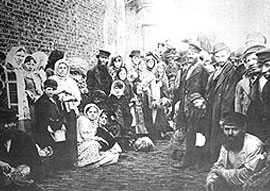
Image: Jews fleeing pogroms, 1882. Public Domain