
Challenges and problems of the Jewish-Christian dialogue from the point of view of a professional in religion.
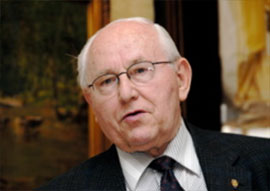
Bert Beach is currently the Director of Public Affairs for the General Conference of Seventh-day Adventists and the General Secretary of the Seventh-day Adventist Council on Interchurch Relations. He is also the Secretary of the Conference of Secretaries of Christian World Communions and the Secretary General of the International Religious Liberty Association. As a regular panelist on the weekly telecast of American Religious Town Hall, Dr. Beach is intensely involved in the discipline of interchurch dialogue.
He is the author of several books, including Vatican II—Bridging the Abyss (1968), Ecumenism—Boon or Bane? (1974), and more recently, Rotating the World With Rotary (1991).
Beach has been the recipient of several honorary awards, such as a special resolution of the Senate of the State of Maryland (November 1984) for his contribution to religious liberty; a Paul Harris Fellow of Rotary International; and a Th.D. honoris causa from the Christian Theological Academy in Warsaw, Poland.
Shabbat Shalom*: The history of the relationship between the Christian Church and Israel is a very painful one. Can you please give us the reason for this failure?
Beach: Yes, indeed, the relationship has been a painful one. A lot of the fault certainly rests on the shoulders of the Christians, without saying that the Jews are perfect and have never made a mistake in their interrelationships. The Christians have called the Jews “Christ-killers” or used some other similar term. Historically, Christians have not infrequently tried to make the Jews living in the contemporary period, or, in other words, the Jews of today, responsible for what some Romans and some Jews did 2,000 years ago. That has colored relationships.
Shabbat Shalom: In the wake of Vatican Council II, do you see any changes taking place in the Christian church in general and in your church in particular?
Beach: Well, certainly Vatican II did mark a watershed as far as Roman Catholic-Jewish relations are concerned. In fact, the Second Vatican Council made a declaration regarding the Jews that indicated that there should be more fraternal relations between the Roman Catholic Church and the Jews, and I think the Roman Catholic Church has acknowledged some of the mistakes that it made in the past. At the time of the Second Vatican Council, I spoke to one of the specialists in the Catholic Church regarding relations with the Jews, and he acknowledged that the Catholic Church had a certain burden of history to carry in regards to its anti-Semitism. I will just give one example: right near the Tiber River is located the entrance to the former Jewish ghetto, and there is a Roman Catholic Church at the entrance. All the Jews going through the entrance into the ghetto would pass right in front of the Roman Catholic Church. The Roman Catholic Church had inscriptions written out; I believe they are still there today. Some years ago, I took pictures of them in Hebrew and in either Latin or Italian, in which they quote from the Old Testament the statement, “I have labored hard and long with this stiff-necked and rebellious people.” The Jews could read these inscriptions as they passed in front and went into the ghetto. This shows some of the past attitude.
Shabbat Shalom: Is the Christian church interested in having a relationship or, if any, a better relationship with Judaism?
Beach: Oh, I think so. In fact, there are societies that have been formed—I’m not sure I remember offhand as I’m speaking here without any notes regarding their names—but there are Jewish-Christian associations that meet together. The Council of Christians and Jews, for example, is one of the world's largest organizations. So there is definitely an improvement in relationships. There are also efforts made to tone down some of the language used by Christians. I’m thinking, for example, of some of the Orthodox liturgy used at the time of Easter with some pretty strong language regarding the Jews. They speak about the Jews, the perfidious Jews. Talking in such generic terms can, of course, be seen as quite anti-Semitic.
Shabbat Shalom: What kind of relationship do you envision between the Christian church and the Jews—a relationship of ecumenical dialogue where everyone is in agreement, or a relationship of imperialistic monologue where the Christian church can bring truth to the Jews, or rather a reciprocal relationship where Christians and Jews will learn from each other and from God?
Beach: Well, certainly the third suggestion is, I think, the best. Ecumenical dialogue is good. And, by the way, dialogue doesn’t mean that participants have to agree with each other; it just means that one tries to be open-minded and willing to both listen and speak. I think imperialistic monologue is of no use to anyone, be it a political monologue or a religious monologue. Christian, or any other, religious imperialism is not in harmony with authentic religion.
Shabbat Shalom: Is there anti-Semitism in the Christian church, and if so, what is your advice on how to deal with this problem?
Beach: Unfortunately, there is anti-Semitism. Sometimes it is hard to know what one means exactly by it, because if somebody is not in favor of the State of Israel and the policies of the State of Israel in the present time—for example, in its relationships with the Middle East or land occupancy and all kinds of problems that arise in regards to the Palestinians and other issues—very often that is interpreted by some as anti-Semitism. I don’t think that a person who has an opposing political viewpoint regarding the State of Israel is ipso facto anti-Semitic. So I think we should be careful how we use the term. Certainly, there is a kind of latent Christian attitude that surfaces from time to time. In fact, in my own church, the Seventh-day Adventist Church, I did a little piece of research and prepared a questionnaire at the time of the Second Vatican Council to see what our own young people were thinking. I presented the questionnaire to the students at several of our schools. If one took the answers from the students at face value, one would have to say that there was some anti-Semitism. For example, one question asked, “Are the Jews responsible for the death of Christ?” The answer very often was "yes." But then, when I discussed the questionnaire with the students and asked them, “What did you really mean by that? Do you really mean to say that a Jew living today is responsible for the death of Christ 2,000 years ago any more than we all are, for He took upon Himself our sins"—then they would say, “Oh, no, I didn’t mean that.” So obviously, the students were answering very often without really thinking through what they were saying. And yet, the very fact that they would answer that way would indicate that there was a kind of latent anti-Semitism there, somehow, without it being clearly articulated or even understood.
Shabbat Shalom: What is the impact of the Holocaust on your view of Israel and the relationship between Christianity and the Jews?
Beach: The Holocaust can be seen as the nadir in human history. No one knows exactly how many Jews were killed, and there are a lot of people who are trying to change the figures, but it makes no difference to me whether they can reduce the figures by 100 or 200,000 or even by one million. The facts are that a tremendous number of Jews were killed, and if there were even only 1,000 Jews, it would still be a terrible thing, and when it’s obviously up in the hundreds of thousands and millions, it is a terrible event. Therefore, I think that society has a certain responsibility to ensure that such a tragedy is never repeated. One can even ask the question, Are the Germans living today responsible for what their ancestors did one or two generations ago? Well, obviously not in any direct sense, though they have a moral and, you might say, maybe even a financial responsibility to repay what the state did to which they now belong. I think the Holocaust played an important role in the establishment of the State of Israel. It makes sense to provide the Jews with some kind of home base, a country with which they can identify. It fits into their history, their desires, and their ambitions, but depending on exactly how large that state should be and where the borders are, I certainly would not be the expert to know the answers to those questions.
Shabbat Shalom: What could the Christian church learn from the Jews?
Beach: Well, I think one thing the Christian church can learn is faithfulness to inherited practices, traditions, and truths. When you think that the Jews have been separated from any home base and have lived for centuries in a diaspora situation, scattered around the face of the earth, yet still have many hundreds of thousands of faithful Jews keeping the Sabbath, waiting for their Messiah, as they would understand it, to come, in that sense, I think we can learn from that faithfulness to their traditions and teachings, respect for their rabbis, respect for the role of the mother in the home, and respect for the beginning of the Sabbath hours. I think these are things we could all learn from.
Shabbat Shalom: What could the Jews learn from the church?
Beach: Well, of course, from our perspective, we would think that the Jews would gain from learning about Jesus Christ, who is the Savior of the world and therefore also their Savior.
Shabbat Shalom: What are the common points that your particular church shares with Judaism?
Beach: As Seventh-day Adventists, we would share understanding regarding certain aspects of the Sabbath. We also agree regarding some dietary practices, though not all. We also, in the United States, support both separation of church and state and freedom of religion. I think these would be the three main points that come to mind immediately when one thinks of Seventh-day Adventists and Jews.
Shabbat Shalom: What should be the contribution of Shabbat Shalom to that matter? Do you have any pertinent advice on what Shabbat Shalom should do?
Beach: Shabbat Shalom has a very difficult task, and I would not claim to have the answers regarding how to deal with this. I think we should try to balance Jewish cultural and religious interests in general and respect for Jewish practices and Jewish history and culture, while at the same time exposing Jews and Christians to each other’s truth. How to keep this in balance is where the editor has to show his gifts.
Shabbat Shalom: Thank you, Dr. Beach, for your time and your challenging observations.
* This interview was conducted by Clifford R. Goldstein.